Outdoor sports facilities require reliable lighting systems that provide sufficient brightness, uniform illumination, and comfortable visibility for players and spectators.
Whether it is a football stadium, hockey field, tennis court, or multi-purpose sports facility, selecting the right LED flood lights for sports fields is essential for achieving good lighting performance.
However, choosing sports floodlights involves more than comparing wattage and lumen output. Beam angles, mounting height, pole positions, glare control, and lighting uniformity all influence the final result.
In this guide, MIC OPTOELECTRONIC CO., LTD explains how to select high-mast LED floodlights for outdoor sports projects and introduces the MFL-G960 high-power LED flood light.
1. Why Do Outdoor Sports Fields Need Professional LED Flood Lighting?
Sports field lighting has different requirements from ordinary outdoor or industrial lighting.
During a game, players need to track fast-moving balls, judge distances, and respond quickly to other players. Poor lighting distribution can create dark areas, excessive brightness, and uncomfortable glare.
A professional sports lighting system should consider four important factors:
- Sufficient Illuminance: The playing surface needs adequate light for clear visibility.
- Lighting Uniformity: Light should be distributed consistently across the entire playing area.
- Glare Control: Proper optical design and fixture positioning help reduce discomfort for players and spectators.
- Light Spill Control: The lighting system should minimize unnecessary light entering surrounding residential or public areas.
For hockey facilities, the International Hockey Federation (FIH) provides separate lighting guidance for televised and non-televised venues.
The required lighting performance depends on the competition category and intended use of the facility.
Therefore, project developers should establish the lighting requirements before selecting floodlights.
2. Key Factors When Choosing LED Sports Floodlights
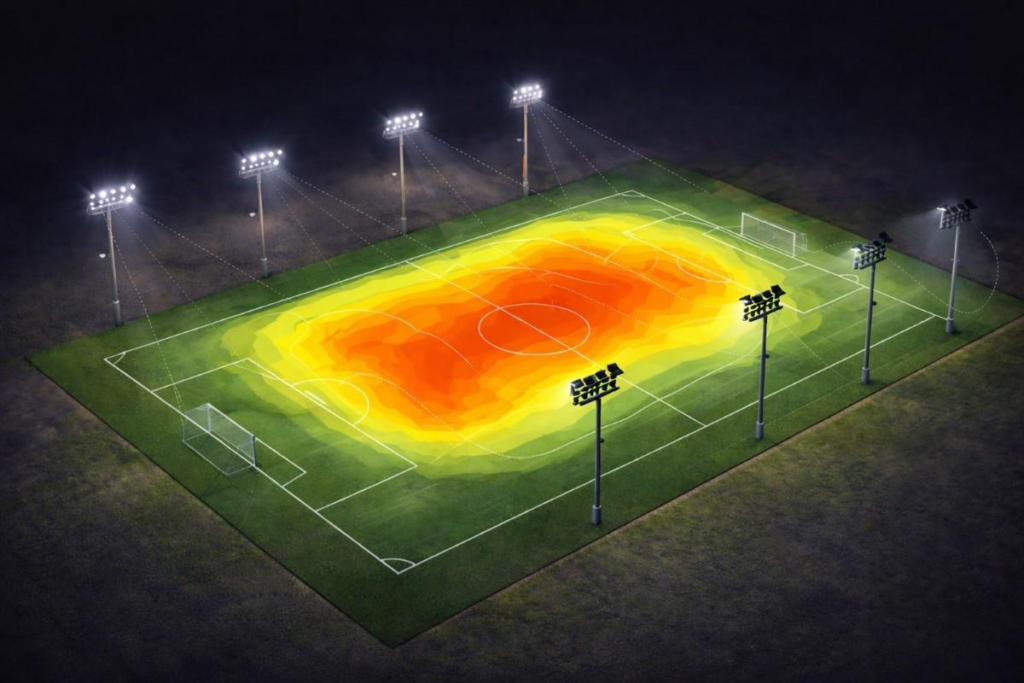
Illuminance and Uniformity
Illuminance, measured in lux, indicates how much light reaches a surface.
The required level varies depending on the sport, facility size, training or competition requirements, and applicable standards.
Average illuminance alone is not enough to evaluate a sports lighting system.
Designers should also consider:
- Average horizontal illuminance across the playing area.
- Minimum and maximum illuminance.
- Minimum-to-average uniformity.
- Minimum-to-maximum uniformity.
- Vertical illuminance where required.
A field may have high average illuminance but still contain dark areas that affect visibility.
Glare Control
High-power LED floodlights can produce intense brightness, especially when installed on tall poles and directed toward a large playing area.
Professional optical lenses help control light distribution and reduce unnecessary glare.
Correct fixture aiming and pole positioning are equally important.
Color Rendering and Color Temperature
Color rendering affects how naturally players, objects, and field markings appear under artificial lighting.
The appropriate color temperature and CRI should be selected according to the project requirements, visual comfort, and any applicable competition specifications.
3. How to Choose Beam Angles and High-Mast Pole Positions
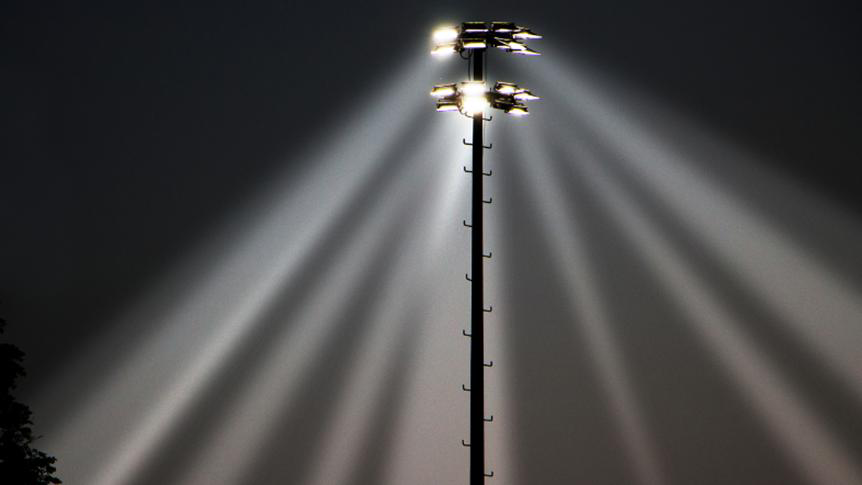
Beam angle is one of the most important specifications when selecting LED floodlights for large outdoor sports fields.
Different beam angles distribute light differently.
A narrow beam concentrates light over a smaller area, while a wider beam covers a larger area.
The correct choice depends on the pole height, distance from the playing surface, pole location, and required illumination.
Common Beam Angle Options
For the MIC MFL-G960 series, available optical configurations include:
- 20°: Suitable for more concentrated light distribution over longer distances.
- 40°: Provides a relatively focused distribution for selected high-mast applications.
- 60°: Offers a balance between concentrated output and wider coverage.
- 90°: Provides broader light distribution.
- 100° × 140°: An asymmetrical option for applications requiring directional light distribution.
The actual suitability of each optical option should be evaluated using photometric data and lighting calculations.
Why Does Pole Height Matter?
High-mast lighting is commonly used for large outdoor sports facilities because elevated mounting positions can help distribute light over extensive playing areas.
However, higher poles do not automatically produce better lighting.
Designers must consider:
- Pole height and distance from the field.
- Number of poles and their positions.
- Number of floodlights installed on each pole.
- Beam angles and aiming directions.
- Required illuminance and uniformity.
- Glare and light spill outside the playing area.
A well-designed layout should distribute light across the field without creating excessive brightness in individual areas.
4. MIC MFL-G960 960W High Power LED Flood Light
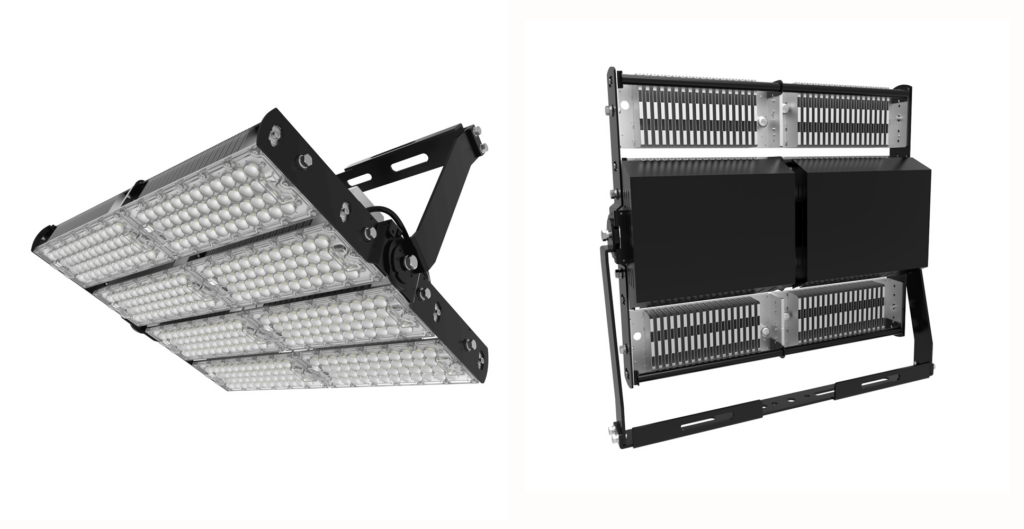
For large outdoor sports facilities, MIC offers the MFL-G960 960W high-power LED flood light, designed for stadiums, sports fields, industrial yards, and other large-area outdoor lighting applications.
Main Product Specifications
|
Specification |
MFL-G960 |
|
Rated Power |
960W |
|
Luminous Flux |
Over 153,600 lm |
|
Luminous Efficacy |
160 lm/W |
|
LED Type |
SMD 5050 |
|
LED Quantity |
368 pcs |
|
IP Rating |
IP66 |
|
Input Voltage |
AC85–305V |
|
Power Factor |
Greater than 0.95 |
|
Driver Options |
Meanwell / Sosen |
|
Symmetrical Beam Angles |
20° / 40° / 60° / 90° |
|
Asymmetrical Beam Angle |
100° × 140° |
Specifications are based on the listed MFL-G960 configuration. Final parameters should be confirmed against the selected product version and technical datasheet.
Key Features
High Luminous Output
With a rated power of 960W and luminous flux exceeding 153,600 lumens, the MFL-G960 provides high-output lighting for large outdoor applications.
Multiple Optical Options
Different symmetrical and asymmetrical beam angles allow lighting designers to select suitable distributions for different mounting positions.
Efficient Thermal Management
The aluminum housing and thermal design help dissipate heat during operation.
Reliable Driver Options
Meanwell and Sosen driver configurations are available, depending on the selected product version.
Outdoor Protection
The listed MFL-G960 specification provides IP66 protection for outdoor lighting applications.
Optional dimming and lighting control configurations can also be discussed for projects requiring more advanced management.
For more product details, visit the MIC MFL-G960 960W LED Flood Light.
5. Real Project Case: Hellenic Hockey Astroturf in Zimbabwe
Real project experience provides valuable information for contractors planning large outdoor sports lighting installations.
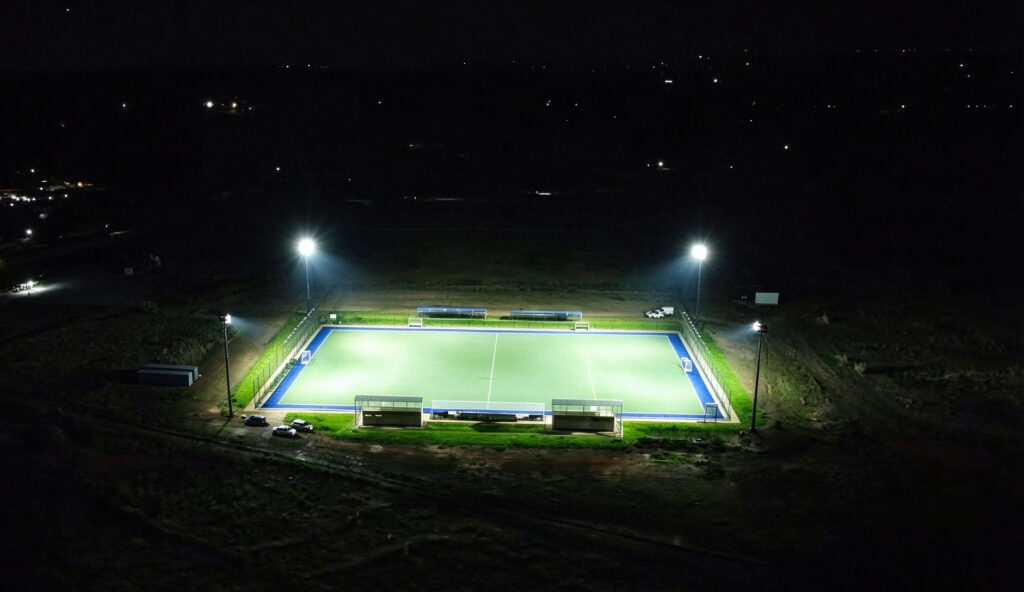
MIC’s Hellenic Hockey Astroturf project in Harare, Zimbabwe, is an example of a high-mast LED floodlighting application.
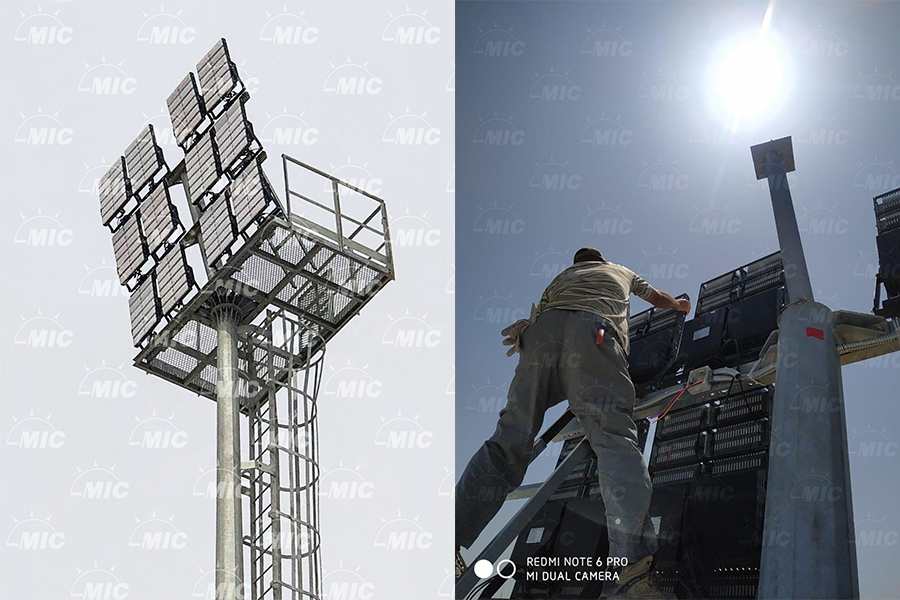
Project Overview
- Location: Harare, Zimbabwe
- Application: Hellenic Hockey Astroturf
- Pole Height: 18 meters
- Lighting Product: MIC MFL-G960 LED Flood Light
- Installation Configuration: 6 × 960W floodlights per pole
- Reported Average Ground Illuminance: Over 300 lux
The project uses high-power LED floodlights mounted on 18-meter poles to illuminate the hockey field.
The reported average ground illuminance exceeded 300 lux, demonstrating the lighting performance achieved under this particular project configuration.
This case provides a useful reference for customers considering similar outdoor hockey field lighting projects.
However, the same arrangement should not be applied automatically to every sports field. Court dimensions, pole positions, optical distributions, and lighting requirements must be evaluated individually.
The reported project result also should not be interpreted as proof of compliance with every FIH competition or broadcasting category.
6. Why Is DIALux Lighting Simulation Important?
Before purchasing high-power LED floodlights, contractors should evaluate the proposed lighting arrangement through professional lighting calculations.
DIALux simulation helps designers assess whether the selected fixtures and installation positions can achieve the required lighting performance.
A typical workflow includes:
- Collecting field dimensions and pole layout information.
- Selecting suitable LED floodlight models and optical distributions.
- Determining fixture quantities and aiming angles.
- Simulating average illuminance and lighting uniformity.
- Reviewing glare and light distribution.
- Adjusting the layout according to project requirements.
This process helps reduce the risk of insufficient lighting, uneven brightness, and unnecessary fixture quantities.
MIC can support customers with product selection and project-oriented lighting design discussions.
7. Frequently Asked Questions About Sports Field LED Floodlights
What wattage LED floodlights are suitable for outdoor sports fields?
The required wattage depends on the field dimensions, pole height, required illuminance, and optical distribution.
High-power models such as the MIC MFL-G960 can be considered for large-area applications, but final selection should be based on lighting calculations.
What is the best beam angle for stadium floodlights?
There is no single beam angle suitable for every stadium.
Narrow beams may be suitable for distant or concentrated lighting positions, while wider or asymmetrical distributions may be more appropriate for other locations.
A photometric simulation helps determine the best combination.
How many floodlights are needed for a hockey field?
The number depends on field dimensions, mounting height, pole arrangement, and the required lighting category.
A project-specific DIALux design is recommended before finalizing the quantity.
Why is lighting uniformity important for sports fields?
Good uniformity helps reduce differences between bright and dark areas, supporting more consistent visibility for players.
Can MIC provide lighting solutions for large sports projects?
MIC supplies high-power LED floodlights, including the MFL-G960 series, for outdoor sports and infrastructure applications.
Customers can share their field dimensions, pole heights, and lighting requirements to discuss suitable product configurations.
Conclusion: Choose the Right LED Floodlight for Your Sports Lighting Project
Selecting LED floodlights for outdoor sports fields requires careful consideration of luminous output, optical distribution, pole height, lighting uniformity, and glare control.
High wattage alone does not guarantee a successful lighting installation.
Professional lighting calculations and suitable fixture positioning are essential for achieving reliable results.
The MIC MFL-G960 960W LED flood light offers high luminous output, multiple beam angle options, and outdoor protection for demanding large-area lighting applications.
Whether you are developing a hockey field, football stadium, tennis complex, or multi-purpose sports facility, MIC can help you explore suitable LED floodlighting options for your project.
Planning an Outdoor Sports Lighting Project?
Send MIC your field dimensions, pole layout, installation height, and lighting requirements. Our team can discuss suitable LED floodlight configurations and project lighting support.
MIC OPTOELECTRONIC CO., LTD
Website: www.mic-led.com
Email: micled@mic-led.com
WhatsApp: +86 135 4334 3078
Professional LED Flood Lighting Solutions for Sports and Infrastructure Projects.