Selecting the right LED street light manufacturer is an important step in any road lighting project. For contractors, distributors, and municipal procurement teams, purchasing decisions involve much more than comparing wattage and price.
An LED street light may look suitable on paper but fail to meet project requirements because of insufficient lighting uniformity, unsuitable optical distribution, inadequate surge protection, or missing technical documentation.
These issues can lead to tender rejection, installation delays, additional costs, and long-term maintenance problems.
Before placing an order, buyers should carefully review the following eight key LED street light specifications to ensure the proposed products match their project requirements.
1. Luminous Efficacy: Check Real Lumens per Watt
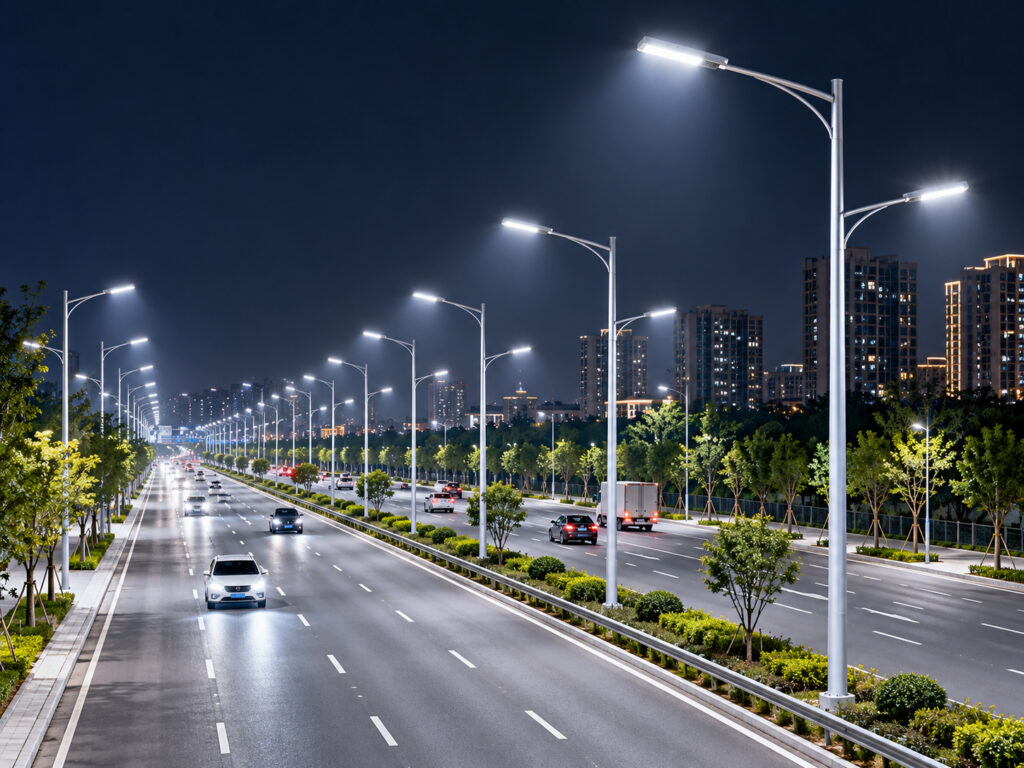
Luminous efficacy, measured in lumens per watt (lm/W), is one of the first specifications buyers should examine.
Higher efficacy means a luminaire can produce more light while consuming less electrical power.
For example, a 100W LED street light rated at 170 lm/W would produce approximately 17,000 lumens under its specified test conditions.
However, high luminous efficacy does not automatically guarantee better road lighting.
Buyers should verify:
- Actual luminaire efficacy rather than LED chip efficacy
- Total luminous flux under rated operating conditions
- Power consumption stated in the test report
- Whether the report matches the proposed product model
Some MIC LED street light configurations have supporting performance test reports around 170 lm/W. Actual efficacy must be confirmed for the selected model and configuration.
For government and infrastructure projects, independent photometric reports can provide valuable evidence of product performance.
2. Optical Distribution: Choose the Right Beam Pattern
The optical design determines how light is distributed across the road surface.
Two LED street lights with identical wattage and luminous flux can produce very different lighting results.
Road width, mounting height, pole spacing, arm length, and luminaire tilt all influence the required optical distribution.
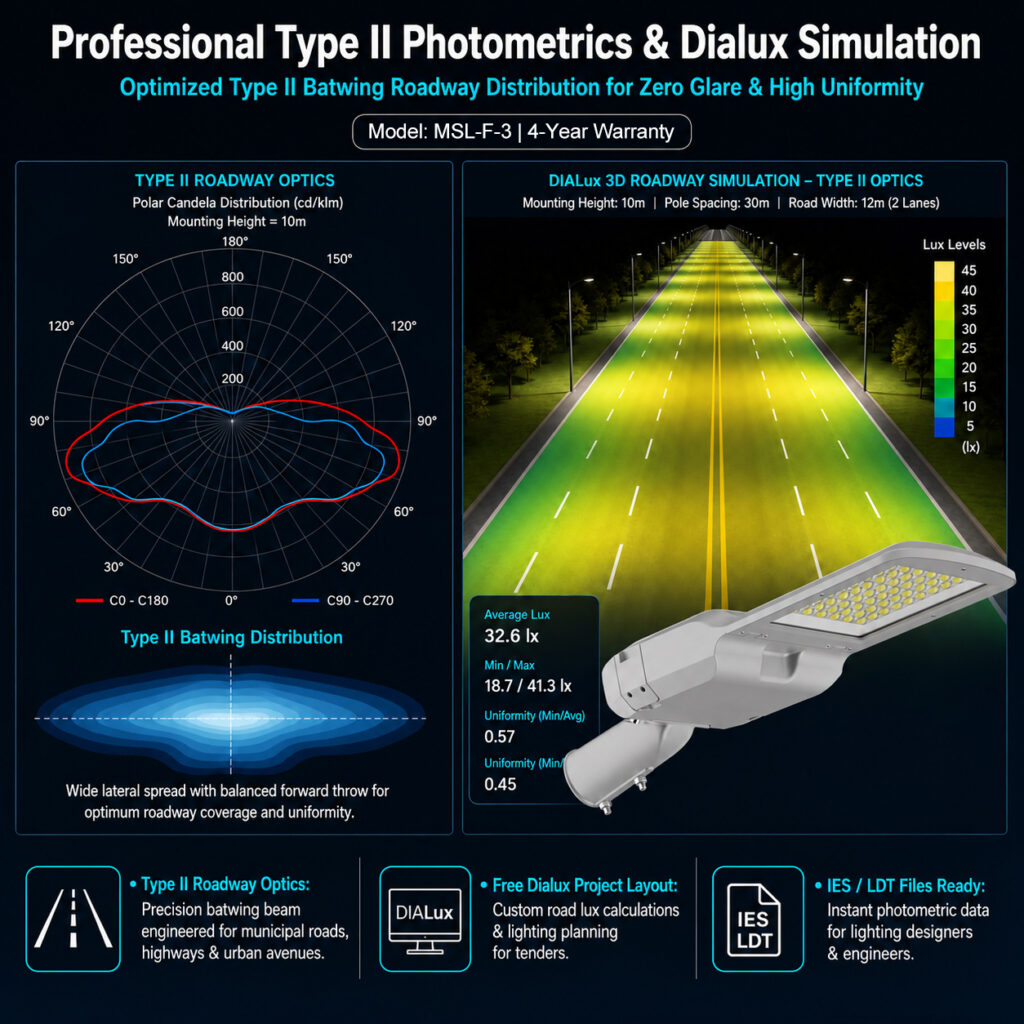
Common roadway optical distributions include Type II, Type III, and Type IV, depending on the project design system.
Buyers should request suitable photometric files and verify:
- Average road illuminance or luminance
- Lighting uniformity
- Glare control
- Pole spacing and mounting height
- Light distribution across traffic lanes and sidewalks
Professional lighting simulation software such as DIALux can help contractors evaluate these factors before purchasing.
3. IP and IK Ratings: Evaluate Outdoor Durability
LED street lights operate outdoors throughout the year, often under demanding environmental conditions.
Dust, heavy rain, humidity, temperature changes, and accidental mechanical impacts can affect long-term reliability.
Two important specifications are:
IP Rating — Ingress Protection
The IP rating indicates protection against solid particles and water.
For example, IP66 provides dust-tight protection and resistance to powerful water jets under the relevant test conditions.
IK Rating — Impact Protection
The IK rating indicates resistance to mechanical impact, which is particularly relevant for public infrastructure and exposed installations.
Before approving a product, contractors should confirm that both ratings meet the project’s technical requirements.
MIC offers IP66-rated LED street light configurations for outdoor applications. The applicable test reports should be checked against the exact model being supplied.
4. Surge Protection: An Important Factor in Road Lighting Reliability
Outdoor LED street lighting systems can be exposed to transient electrical surges caused by lightning activity and power network switching.
Insufficient surge protection may damage LED drivers or other electronic components, increasing maintenance costs.
For this reason, many roadway lighting tenders specify minimum surge withstand requirements.
Important points to check include:
- Standard surge protection level
- Availability of upgraded protection
- Relevant test conditions
- Compatibility with the project electrical system
For MIC’s applicable MSL-F-3 configurations, standard 6kV surge protection and optional 10kV protection can be considered according to project requirements.
Buyers should confirm the final surge protection configuration before ordering, especially for projects in areas with frequent thunderstorms.
5. LED Driver and Electrical Compatibility
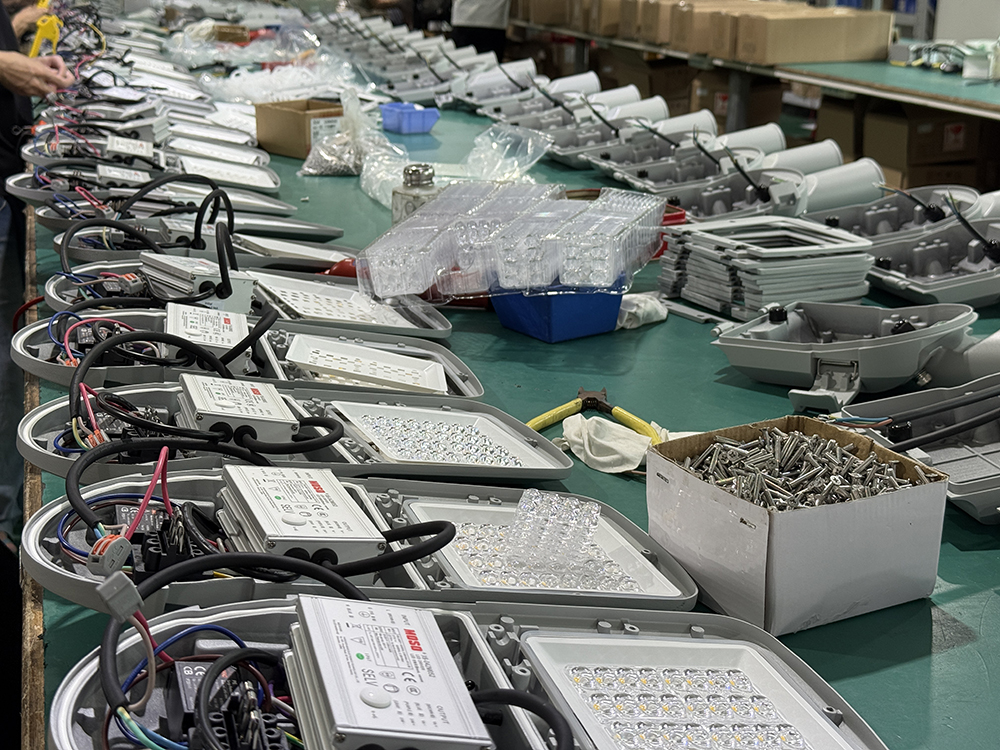
The LED driver plays an important role in the electrical performance and reliability of a street lighting system.
Before purchasing, buyers should verify whether the driver is suitable for the local electricity supply and project operating conditions.
Key specifications include:
- Input voltage and frequency
- Power factor and harmonic distortion
- Operating temperature range
- Electrical protection features
- Dimming compatibility
- Driver warranty and replacement options
A product designed for one electrical market may require a different driver configuration for another country.
Contractors should therefore confirm electrical compatibility with the manufacturer rather than assuming all product versions are identical.
6. Smart Lighting Controls: Plan for Future Upgrades
Smart street lighting systems can help municipalities and facility operators manage operating schedules, energy consumption, and maintenance activities.
Depending on the project, suitable control options may include:
- 0-10V dimming
- Photocell-based automatic switching
- Programmable dimming schedules
- NEMA or Zhaga interfaces
- Optional IoT-based lighting management
For projects considering future smart city upgrades, it is important to discuss control compatibility during the procurement stage.
MIC provides configurable control options for selected street lighting products, allowing customers to discuss their control requirements before production.
Not every control feature is included in the standard product configuration, so buyers should confirm the selected options in their technical quotation.
7. Certifications and Test Reports: Verify Tender Compliance
Different countries and infrastructure projects may require different product certifications and technical documentation.
Before selecting a supplier, buyers should carefully review the tender documents and confirm which reports are mandatory.
Commonly requested documents include:
|
Technical Document |
Purpose |
|
Product Datasheet |
Confirms model specifications |
|
LM-79 Report |
Verifies photometric and electrical performance |
|
LM-80 Data |
Supports LED source lumen maintenance evaluation |
|
IES File |
Provides photometric data for lighting calculations |
|
IP / IK Test Reports |
Supports environmental and impact ratings |
|
Electrical Safety Documentation |
Supports applicable market requirements |
|
Warranty Statement |
Defines warranty scope and conditions |
The availability of a certificate is not sufficient by itself. Buyers should verify the covered model, test conditions, validity, and relevance to the tender.
Working with a manufacturer that can provide organized technical documentation can simplify project evaluation and approval.
8. Maintenance, Installation, and Long-Term Cost
For large road lighting projects, the initial luminaire price represents only part of the total investment.
Installation labor, electricity consumption, replacement components, and future maintenance can significantly affect operating costs.
Before finalizing an order, contractors should consider:
- Luminaire weight and mounting compatibility
- Driver accessibility and serviceability
- Availability of replacement components
- Housing and thermal management design
- Warranty coverage
- Expected maintenance requirements
A well-designed LED street light should combine reliable performance with practical installation and service features.
Evaluating these factors helps buyers compare the long-term value of different proposals instead of focusing only on the lowest purchase price.
MIC MSL-F-3 LED Street Light Solutions
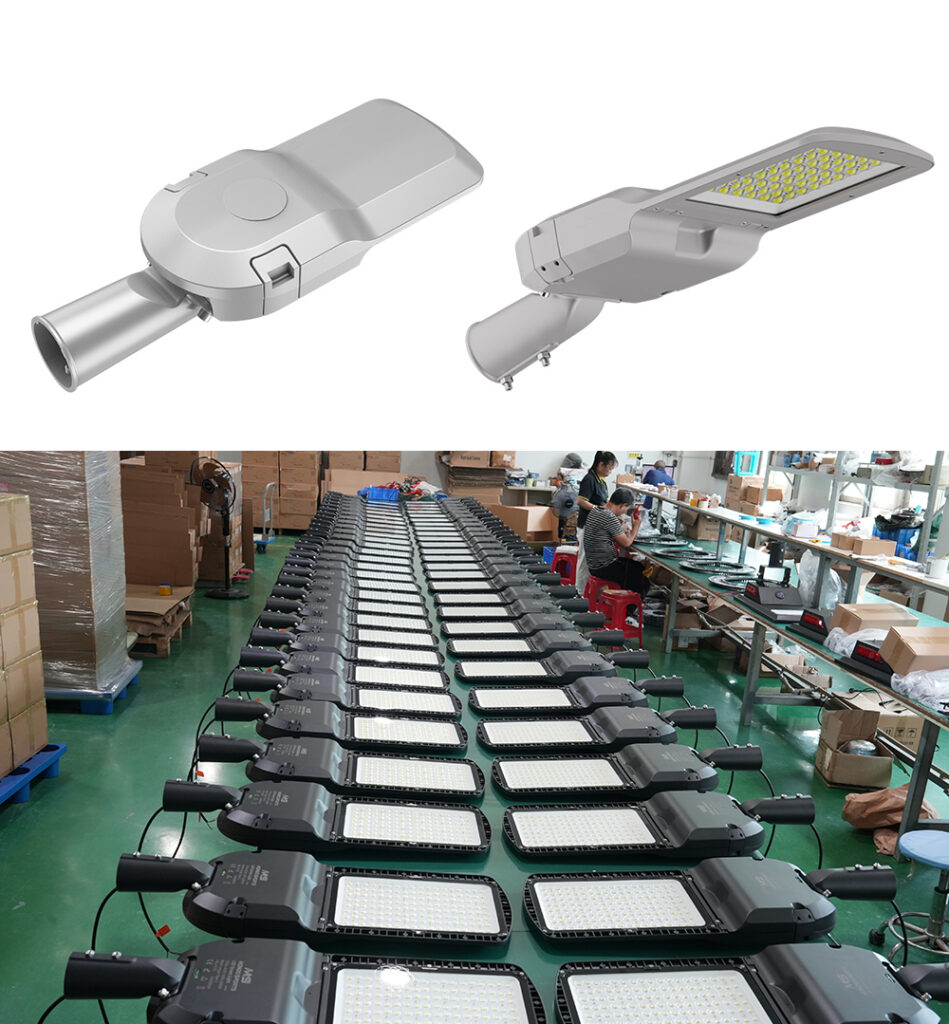
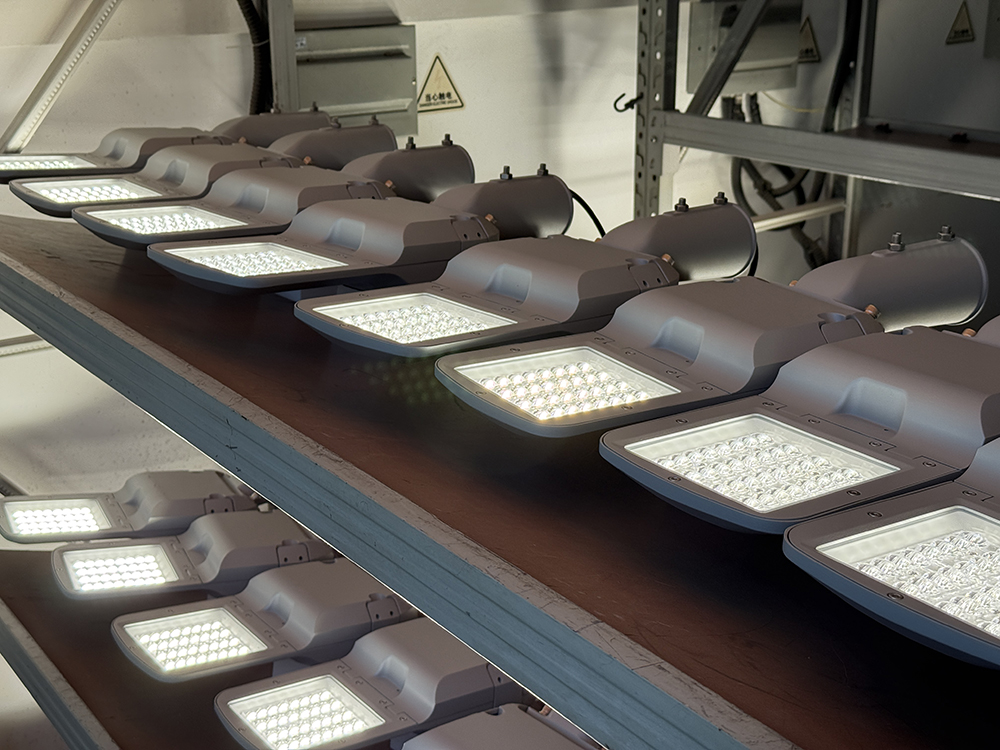
For international road lighting projects, MIC OPTOELECTRONIC CO., LTD offers LED street light solutions designed for outdoor infrastructure applications.
The MIC MSL-F-3 product family includes different wattage configurations, optical options, and mounting designs to meet a variety of road lighting requirements.
Depending on the selected model, available features may include:
- High-efficiency LED lighting
- IP66 outdoor protection
- Roadway optical distribution options
- Aluminum housing design
- Optional surge protection upgrades
- Configurable dimming and smart control interfaces
The MSL-F-3 series provides product options for municipal roads, urban streets, commercial developments, and infrastructure projects.
For tender applications, MIC can discuss the required product configuration, technical documentation, and photometric design requirements with contractors and distributors.
What Should Buyers Send Before Requesting a Quotation?
A detailed request for quotation helps suppliers recommend suitable products and prepare more accurate technical proposals.
Before contacting an LED street light manufacturer, buyers should prepare:
- Road dimensions and project location
- Required fixture wattage or lighting performance
- Pole height, spacing, and mounting arrangement
- Required optical distribution
- Input voltage and control requirements
- IP, IK, surge protection, and certification requirements
- Estimated project quantity and delivery schedule
If a tender specification or lighting design is already available, sharing those documents can make the evaluation process more efficient.
Frequently Asked Questions
What is the most important specification when buying LED street lights?
There is no single specification that determines product suitability. Buyers should evaluate luminous efficacy, optical distribution, electrical performance, environmental protection, and compliance with project requirements together.
Is IP66 suitable for outdoor LED street lights?
IP66 is commonly used for outdoor street lighting products because it provides dust-tight protection and resistance to powerful water jets. However, the final requirement depends on the installation environment and tender specifications.
Why should buyers request an IES file?
An IES file contains photometric information that lighting designers can use to simulate road illumination, check uniformity, and evaluate proposed pole arrangements.
Can LED street lights be customized for different markets?
Yes. Depending on the product design and available configurations, manufacturers may offer different input voltages, optical distributions, control interfaces, and protection features to meet regional project requirements.
Conclusion: Choose a Street Light Supplier Based on Verified Performance
Successful LED street lighting procurement requires more than selecting an attractive product or comparing prices.
By carefully checking these eight specifications, contractors and project buyers can reduce technical risks and make more informed purchasing decisions.
For large-scale infrastructure projects, photometric performance, electrical compatibility, verified protection ratings, and complete technical documentation are especially important.
MIC OPTOELECTRONIC CO., LTD supplies LED street lighting solutions for international distributors, contractors, and infrastructure projects.
If you are preparing an LED street light tender or looking for a reliable manufacturing partner, send us your project specifications and lighting requirements.
Contact MIC OPTOELECTRONIC CO., LTD
Website: www.mic-led.com
Email: micled@mic-led.com
WhatsApp: +86 135 4334 3078
MIC — Professional LED Lighting Solutions for Road and Infrastructure Projects.