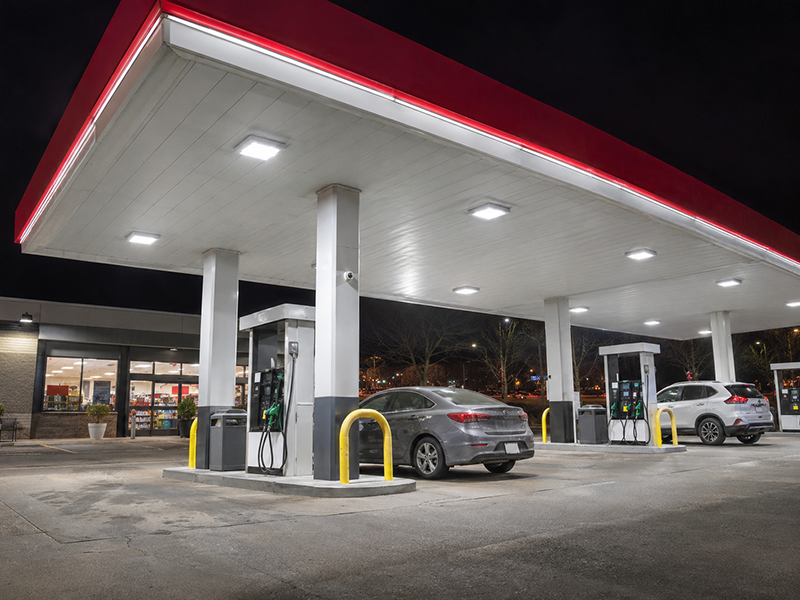
Choosing the right LED canopy lights for gas stations is an important decision for fuel station owners, electrical contractors, and lighting distributors.
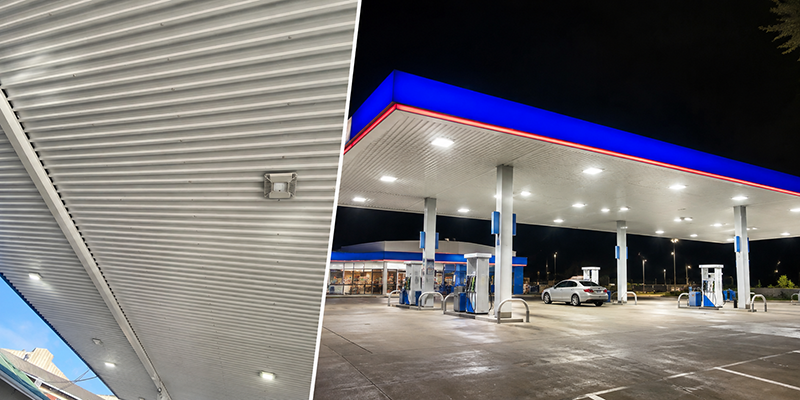
Gas stations often operate for extended hours, making lighting essential for customer visibility, daily operations, and energy management.
Traditional metal halide and high-pressure sodium lighting systems may consume considerable electricity and require regular maintenance. Modern LED canopy lighting offers an energy-efficient alternative with improved light control and flexible installation options.
However, selecting suitable LED fixtures involves more than comparing wattage and price.
This guide explains how to evaluate brightness, optical distribution, outdoor protection, energy savings, and product specifications, while introducing the MIC CP03 LED Canopy Light series for commercial fuel station lighting projects.
1. Why Is Professional LED Canopy Lighting Important for Gas Stations?
Gas station lighting serves several purposes beyond illuminating the fuel pumps.
Drivers need to see vehicle routes, fuel dispensers, payment areas, and surrounding obstacles clearly. Staff also require reliable illumination for daily operations and maintenance.
A well-designed gas station lighting system should provide:
- Adequate Brightness: Sufficient illumination for vehicle movement, customer activities, and fuel dispensing operations.
- Uniform Lighting: Consistent light distribution across the fueling area without excessively bright or dark zones.
- Visual Comfort: Controlled glare to improve visibility for drivers and customers.
- Energy Efficiency: Reduced electricity consumption during extended operating hours.
- Reliable Outdoor Performance: Suitable protection against moisture, dust, and environmental conditions.
For new gas stations and renovation projects, selecting the right LED canopy lights can improve lighting performance while reducing long-term operating costs.
2. How to Choose the Right Wattage and Brightness
One of the most common questions from project buyers is:
How many watts should an LED canopy light have for a gas station?
The answer depends on the canopy height, covered area, fixture spacing, required illuminance, and lighting distribution.
For example, a small fueling station may require a different lighting arrangement from a large highway service station with multiple fueling islands.
Wattage vs. Luminous Output
Wattage indicates electrical power consumption, while luminous flux, measured in lumens, represents the total visible light produced by a luminaire.
A higher-wattage fixture does not necessarily provide better lighting if its optical distribution is unsuitable.
MIC offers several CP03 canopy lighting configurations:
|
Model |
Power |
Listed Luminous Flux |
|
CP03-XX02 |
150W |
Over 19,500 lm |
|
CP03-XX03 |
200W |
Over 26,000 lm |
|
CP03-XX04 |
240W |
Over 31,200 lm |
These options allow contractors to consider different lighting outputs according to their project requirements.
The final selection should be based on actual luminaire performance and lighting calculations rather than wattage alone.
3. Why Do Beam Angle and Lighting Uniformity Matter?
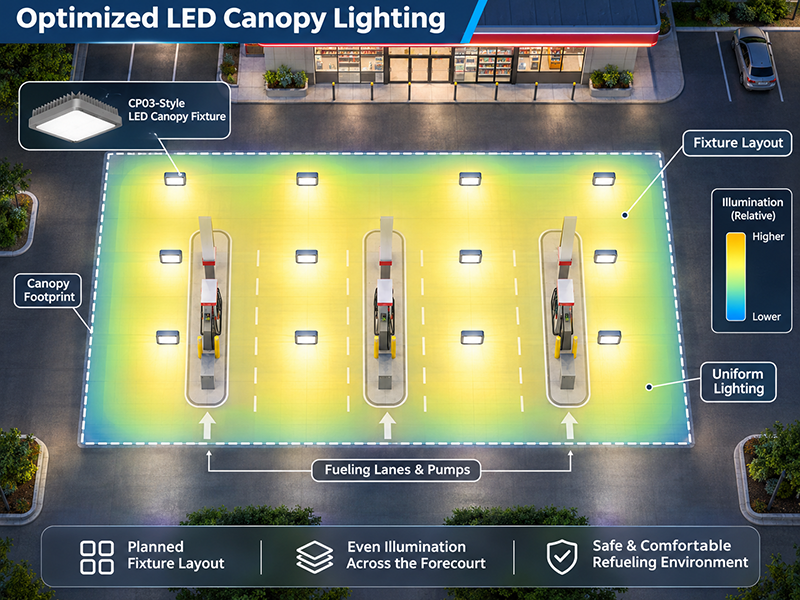
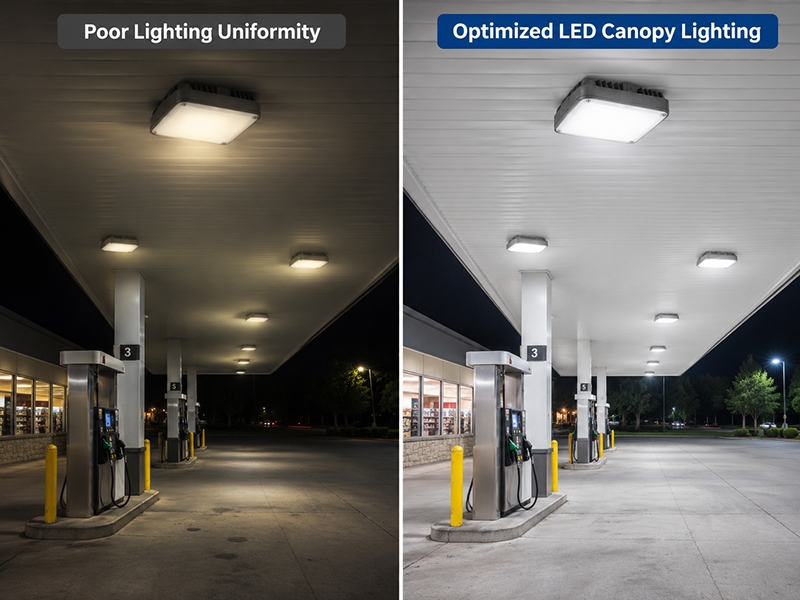
Lighting uniformity is particularly important for gas stations because the covered area usually contains several fueling positions.
Poor fixture placement may result in excessive brightness directly below the lights while leaving other areas insufficiently illuminated.
The correct optical distribution helps direct light toward the required surfaces.
Factors Affecting Lighting Distribution
- Canopy mounting height and dimensions.
- Distance between LED canopy fixtures.
- Fixture optical distribution and luminous output.
- Position of fuel dispensers and vehicle lanes.
- Required horizontal and vertical illumination.
In addition to average illuminance, lighting designers should review minimum illuminance, uniformity, and glare.
Professional lighting simulation software such as DIALux can help evaluate fixture quantities, spacing, and light distribution before installation.
4. MIC CP03 LED Canopy Light: A Practical Solution for Gas Stations
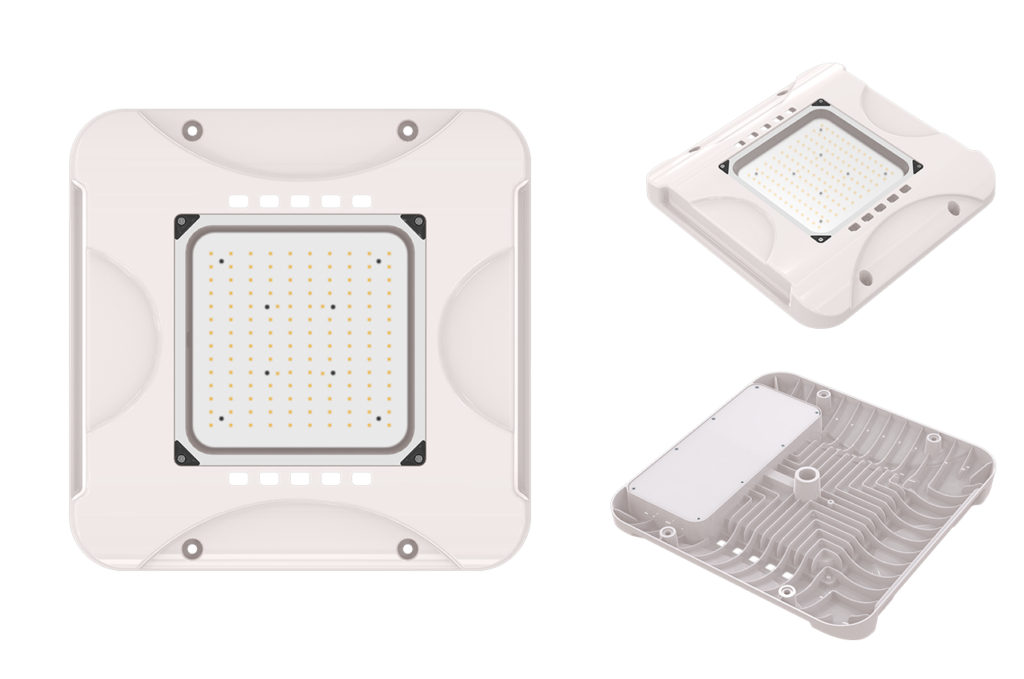
For commercial fuel station lighting projects, MIC OPTOELECTRONIC CO., LTD offers the CP03 LED Canopy Light series.
The series includes 150W, 200W, and 240W configurations designed for high-output commercial and industrial lighting applications.
Key Product Features
High-Efficiency LED Technology
The CP03 series uses SMD 3030 LED technology, providing different luminous output options for commercial lighting projects.
IP65 Outdoor Protection
The published CP03 specifications list IP65 protection, helping protect the luminaire against dust and water exposure under the applicable test conditions.
Durable Housing Design
The series features a protective housing with a powder-coated finish, designed for commercial lighting environments.
Practical Maintenance
The integrated lighting design supports relatively straightforward installation and maintenance compared with conventional lamp-and-ballast systems.
Optional Microwave Motion Sensor
Selected configurations can be equipped with microwave motion sensing for applications where occupancy-based control is appropriate.
For continuously occupied fueling areas, sensor control must be planned carefully to maintain the required illumination during operation.
Important Safety Considerations
Gas stations may include hazardous areas where flammable vapors or gases can be present.
An IP65 rating indicates environmental protection; it does not mean that a luminaire is explosion-proof or approved for installation in a hazardous classified location.
Before selecting canopy lighting, contractors should verify the site’s hazardous-area classification and the applicable electrical regulations.
Fixtures installed in classified locations must have appropriate approvals for those conditions.
For detailed product information, explore the MIC CP03 LED Canopy Light series at www.mic-led.com.
5. LED vs. Traditional Gas Station Lighting: Energy Savings
One of the main advantages of modern LED gas station canopy lighting is the potential reduction in electricity consumption.
Traditional lighting installations may use 250W or 400W metal halide fixtures, often with additional ballast losses.
Replacing older lighting systems with properly designed LED fixtures can reduce power consumption while improving light distribution and maintenance efficiency.
Example: Replacing a 250W Metal Halide Lamp
Consider a simplified example comparing a 250W metal halide lamp with a 150W LED canopy light.
Assuming both operate for 12 hours per day:
|
Item |
Metal Halide |
LED Canopy |
|
Lamp Power |
250W |
150W |
|
Operating Hours |
12 hours/day |
12 hours/day |
|
Daily Consumption |
3.0 kWh |
1.8 kWh |
|
Annual Consumption |
1,095 kWh |
657 kWh |
Estimated annual electricity saving: 438 kWh per fixture.
For a gas station operating 20 fixtures under the same assumptions, the theoretical annual saving would be approximately 8,760 kWh.
This example excludes metal halide ballast losses and assumes equal operating hours. Actual savings depend on existing system power, LED configuration, electricity rates, and required lighting performance.
A professional lighting assessment is necessary to ensure the replacement fixtures meet the required illuminance and uniformity.
6. What Should Buyers Check Before Ordering LED Canopy Lights?
For lighting distributors, EPC contractors, and fuel station developers, purchasing decisions should consider both product specifications and installation conditions.
Before requesting a quotation, prepare the following information:
- Canopy dimensions and installation height.
- Existing fixture quantity and mounting arrangement.
- Required illuminance and lighting uniformity.
- Local input voltage and frequency.
- Environmental protection requirements.
- Hazardous-area classification and required product approvals.
- Preferred color temperature and control options.
- Estimated order quantity and project schedule.
Contractors should also request the relevant product datasheets, photometric files, and applicable test reports.
For retrofit projects, the existing mounting openings, ceiling construction, electrical connections, and fixture dimensions should be checked before installation.
7. Frequently Asked Questions About Gas Station LED Canopy Lighting
What wattage LED canopy light is suitable for a gas station?
The required wattage depends on the canopy height, fixture spacing, covered area, and lighting requirements. MIC offers CP03 configurations from 150W to 240W for different commercial applications.
Is IP65 suitable for gas station canopy lighting?
IP65 provides protection against dust and water jets. However, the required environmental and electrical safety approvals depend on the specific installation location and applicable regulations. IP65 does not indicate explosion-proof certification.
Can LED canopy lights replace metal halide fixtures?
Yes. LED canopy lights are commonly considered for replacing traditional metal halide lighting systems. The replacement should be selected based on actual power consumption, luminous output, optical performance, and installation compatibility.
How many LED canopy lights are needed for a gas station?
Fixture quantity depends on the total covered area, canopy height, required illumination, and the selected luminaire’s photometric characteristics. A lighting calculation is recommended before finalizing the design.
Conclusion: Choose LED Canopy Lighting Based on Project Requirements
Selecting the right LED canopy lights for gas stations requires a balance between brightness, uniform illumination, electrical safety, durability, and energy efficiency.
Rather than choosing fixtures based only on wattage or price, contractors should consider actual lighting performance and long-term operating costs.
The MIC CP03 LED Canopy Light series, available in 150W, 200W, and 240W configurations, provides practical options for commercial canopy lighting applications.
Whether you are developing a new fuel station or upgrading an existing lighting system, MIC can help you explore suitable LED products based on your project requirements.
Looking for LED Canopy Lighting for Your Project?
Send us your canopy dimensions, mounting height, lighting requirements, and estimated quantity to discuss a suitable LED lighting solution.
MIC OPTOELECTRONIC CO., LTD
Website: www.mic-led.com
Email: micled@mic-led.com
WhatsApp: +86 135 4334 3078
Professional LED Lighting Solutions for Commercial and Industrial Projects.