Why Lighting Uniformity Matters More Than Illuminance
From Stadiums to Ports, Great Lighting Starts with Proper Design
In large-scale lighting projects, the first metric most people focus on is usually illuminance (lux).
However, even when the required lux level is achieved, the lighting result may still be far from ideal.
In many real-world applications, the key factor that determines visual comfort, safety, and operational efficiency is lighting uniformity.
For stadiums, logistics centers, industrial facilities, and port areas, a well-balanced light distribution helps reduce visual fatigue, improve work efficiency, and create a safer working environment.
Why Does Lighting Still Look Poor Even When Lux Is Satisfied?
Many projects experience similar issues after installation:
- Certain areas appear too dark
- Significant contrast between bright and dark zones
- Increased visual fatigue for workers
- Poor visibility during night operations
- Inefficient use of energy
These problems are usually not caused by insufficient fixture quantity, but by a lack of attention to lighting uniformity during the design stage.
Simply put:
Lighting should not only be bright — it must be evenly distributed.
What Is Lighting Uniformity?
Lighting uniformity describes how evenly light is distributed across a given area.
It is typically expressed as the ratio between minimum illuminance and average illuminance.
- High uniformity → balanced light distribution
- Low uniformity → noticeable bright and dark zones
Poor uniform lighting may result in:
- Increased visual fatigue
- Reduced operational efficiency
- Higher safety risks
- Poor visibility for surveillance and monitoring
- Localized energy waste
Therefore, uniformity has become a key design parameter, equally important as illuminance.
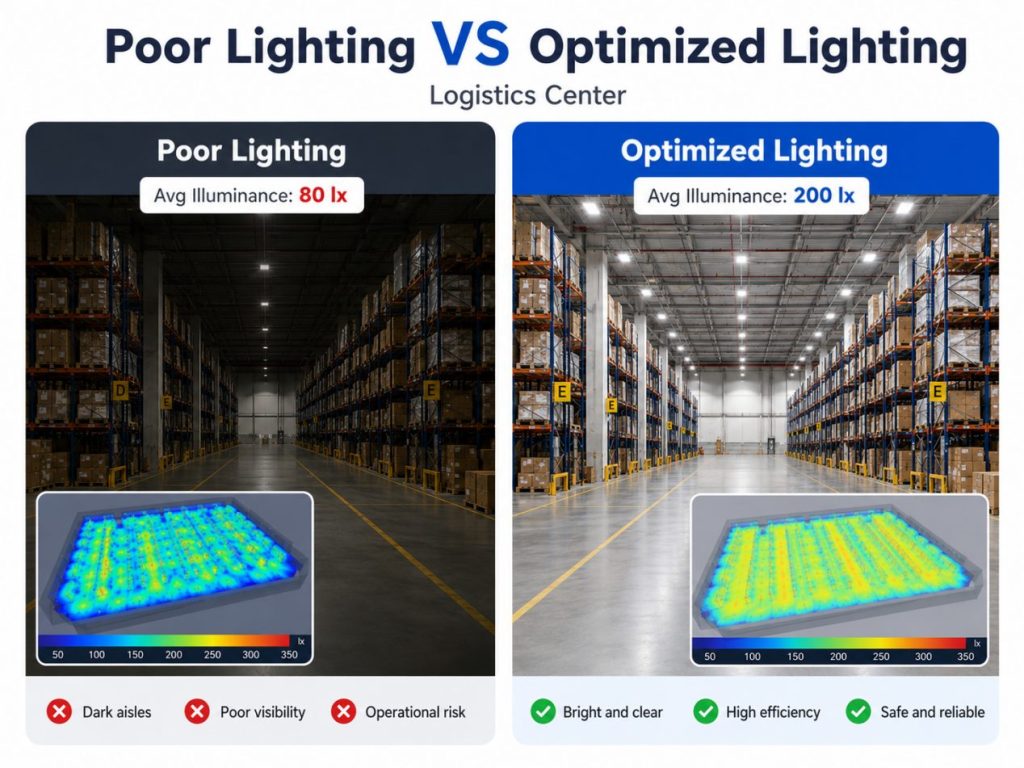
As shown above, the same warehouse environment can deliver completely different results depending on the lighting design approach.
The optimized solution not only improves overall brightness but also ensures a more balanced light distribution, enhancing both safety and operational efficiency.
Why More Projects Rely on DIALux Lighting Simulation
As project scale continues to grow, experience-based lighting design is no longer sufficient for modern engineering requirements.
This is why more consultants and contractors now use DIALux lighting simulation for design validation.
Through simulation, engineers can evaluate:
- Illuminance distribution
- Lighting uniformity
- Luminaire layout
- Beam coverage
- Energy performance
This helps identify potential issues before installation and reduces costly redesign work later.
Stadium Lighting: Uniformity Defines Visual Experience
Stadium lighting requires not only sufficient brightness but also consistent illumination across the entire field.
Poor uniformity may affect:
- Player visibility and performance
- Audience experience
- Broadcast quality
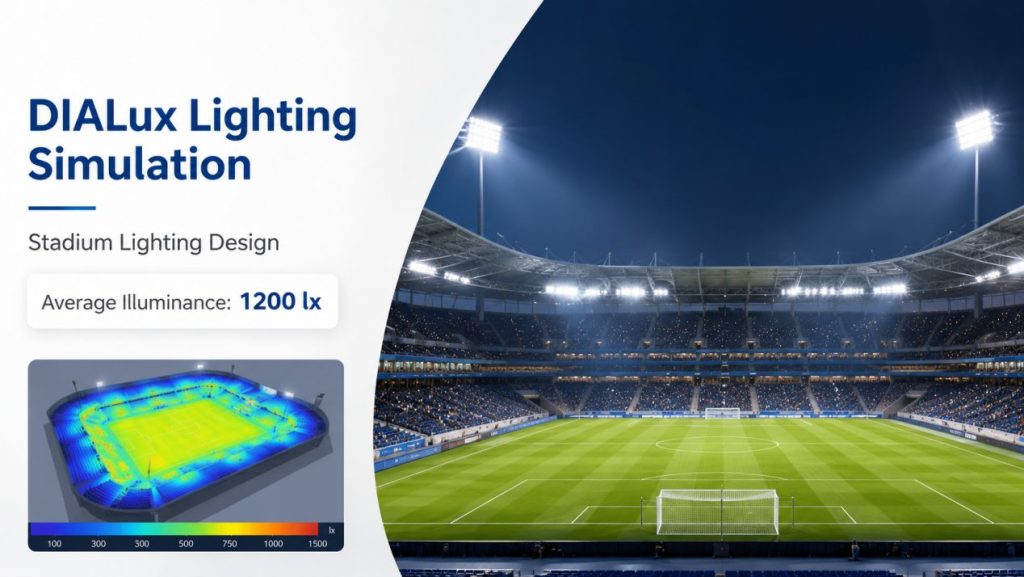
Through simulation, fixture positions and aiming angles can be optimized to ensure a stable and uniform lighting environment across the entire field.
Logistics Center Lighting: Efficiency and Safety Depend on It
Modern logistics centers typically include high racking systems, long aisles, and continuous operations.
Poor lighting uniformity may lead to:
- Difficulty in cargo identification
- Increased forklift operation risks
- Reduced operational efficiency
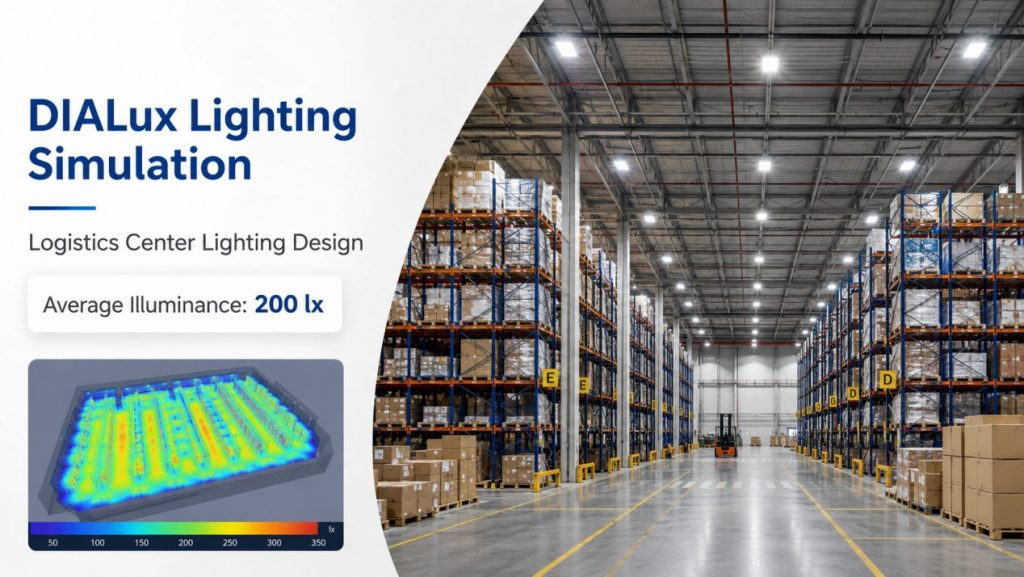 With proper layout design and simulation-based optimization, lighting coverage can be significantly improved, enhancing overall operational performance.
Industrial Facility Lighting: Ensuring Stable Operations
Industrial environments require high levels of lighting stability and uniformity.
Production lines, machinery areas, and inspection zones all depend on reliable illumination.
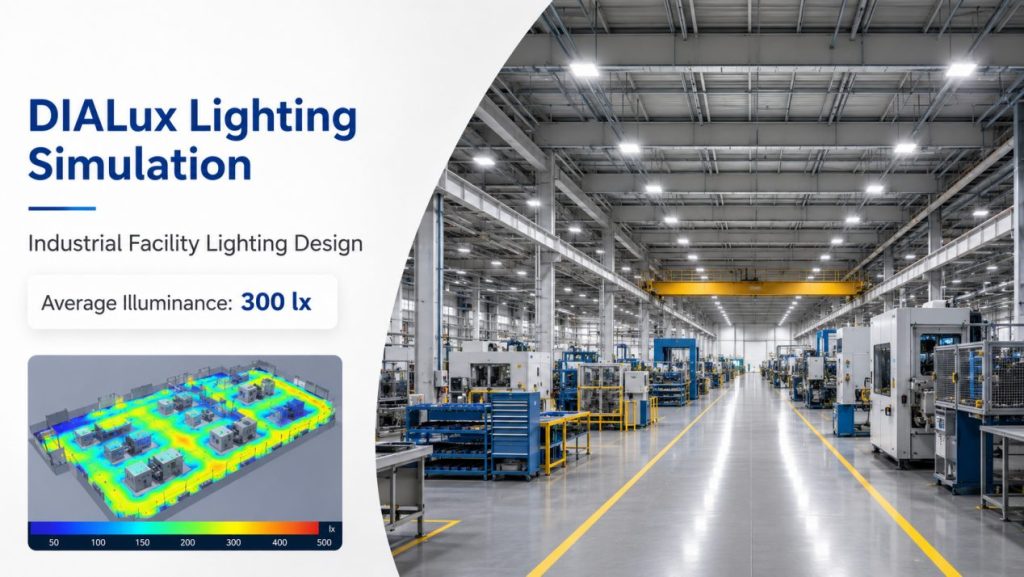 Lighting simulation helps identify potential dark zones in advance, optimize fixture layout, and improve overall workplace safety and visibility.
Port Lighting: Large-Area Coverage Challenges
Ports and container yards typically cover very large areas and often require high mast installations.
Poor design may lead to:
- Uneven light distribution
- Excessively bright or dark zones
- Higher energy consumption
- Safety risks during night operations
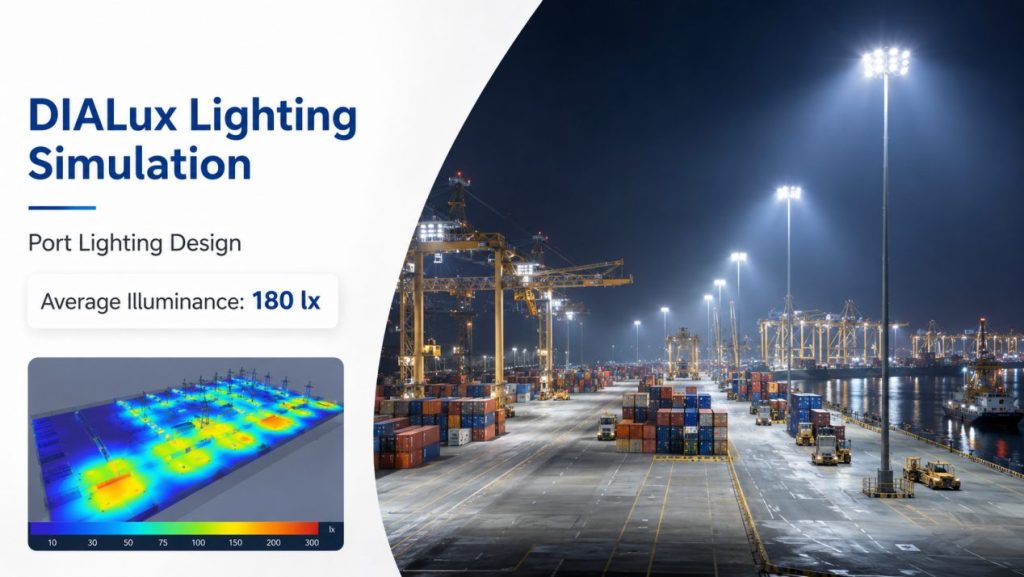 With professional lighting design and simulation analysis, a more balanced light distribution can be achieved, improving both safety and energy efficiency in large outdoor areas.
From Design to Reality: Lighting System Types Matter
Lighting simulation defines how a project should perform, but real-world results also depend on selecting the right lighting systems.
In large-scale outdoor and industrial applications, different types of lighting solutions are commonly used, such as:
- LED Flood Lights (for wide-area illumination)
- LED High Bay Lights (for indoor industrial environments)
- High Mast Lighting Systems (for ports, yards, and large open areas)
A high mast lighting system typically consists of multiple floodlights mounted on a tall pole structure, designed to achieve wide-area and highly uniform illumination.
Only by combining proper design with the right lighting system can simulation results be accurately translated into real-world performance.
About MIC LED
MIC LED focuses on large-scale outdoor and industrial lighting solutions for stadiums, logistics centers, industrial facilities, and port projects.
We provide a wide range of lighting products and system solutions, including LED flood lights, high bay lights, and high mast lighting systems, combined with professional DIALux lighting simulation support.
By integrating lighting design with proper product selection, we help clients achieve higher lighting uniformity, improved visual performance, and better energy efficiency.
📧 Email: micled@mic-led.com
🌐 Website: www.mic-led.com
💬 WhatsApp: +86 135 4334 3078