The three Most Overlooked Issues in Port and Container Terminal Lighting Projects
Ports and container terminals operate around the clock. From cargo handling and container stacking to crane operations and vehicle movement, lighting plays a critical role in ensuring safety, productivity, and operational efficiency.
When planning a port lighting project, many decision-makers focus primarily on fixture wattage and lumen output. However, some of the most common lighting problems are often caused by factors that receive far less attention during the design stage.
In reality, successful port lighting is not simply about making an area brighter. It is about providing adequate illumination where it matters most, controlling glare, and ensuring long-term reliability in harsh marine environments.
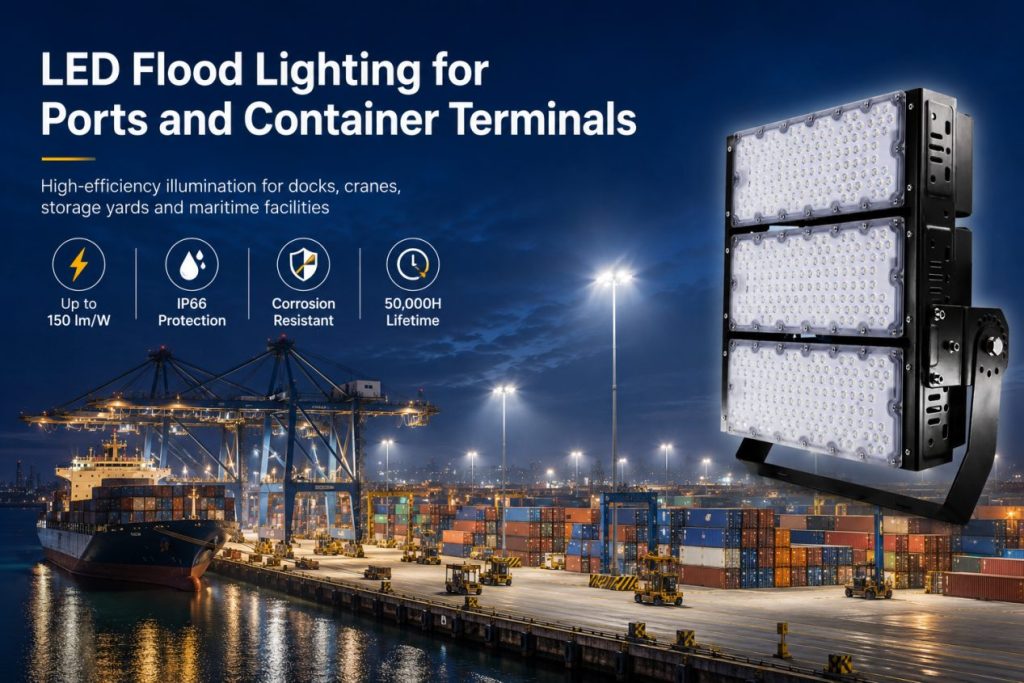
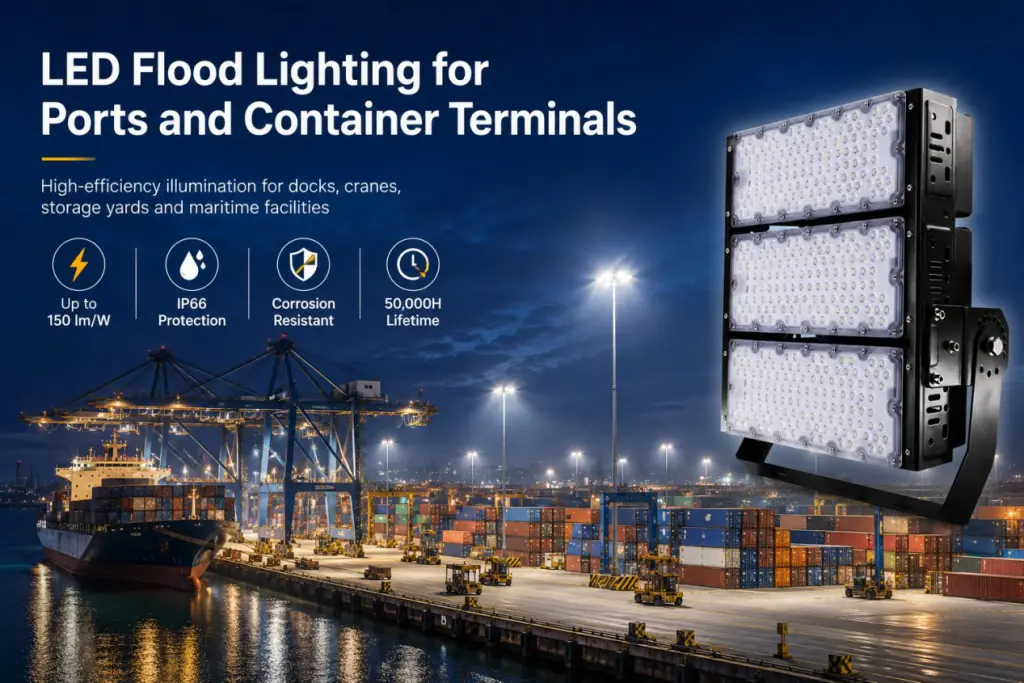
Problem #1: Insufficient Illumination in Critical Areas
Not all areas within a port require the same lighting strategy.
Loading zones, container yards, access roads, crane working areas, and docking facilities each have different visibility requirements. A lighting system designed only around average brightness may still leave critical operational areas underlit.
Common consequences include:
- Dark zones between container stacks
- Poor visibility in loading and unloading areas
- Reduced safety for vehicle operators
- Uneven illumination across work surfaces
- Increased risk of accidents during night operations
Many projects technically meet illumination standards, yet operators still report visibility issues. In most cases, the problem is not insufficient fixture power but rather improper fixture placement, mounting height, or beam angle selection.

For this reason, lighting layout is often more important than simply increasing the number of fixtures.
During the design phase, factors such as site dimensions, pole height, operating zones, and required lux levels should all be considered. A properly designed lighting system can improve visibility while reducing energy consumption and installation costs.
Problem #2: Excessive Glare Reduces Visibility
In port lighting applications, brighter is not always better.
Poorly controlled light distribution can create excessive glare that directly affects crane operators, truck drivers, equipment operators, and personnel working on site.
Glare is particularly problematic in:
- Container transportation routes
- Crane operation zones
- High-mast lighting systems
- Dockside working areas
- Vessel berthing locations
Excessive glare can cause visual discomfort, reduce reaction times, and negatively impact operational safety.

This is why modern port lighting projects should focus not only on lumen output but also on optical performance.
Proper beam control helps direct light precisely where it is needed while minimizing wasted light and visual disturbance. Well-designed optics can significantly improve visibility without increasing energy consumption.
For large container terminals, beam distribution and glare control often have a greater impact on performance than simply installing higher-wattage fixtures.
Problem #3: Ignoring Corrosion Resistance in Marine Environments
One of the most underestimated challenges in port lighting is environmental durability.
Ports are continuously exposed to salt spray, humidity, wind, rain, and extreme temperature fluctuations. These conditions can rapidly accelerate corrosion and shorten the lifespan of lighting equipment.
Without adequate protection, lighting fixtures may experience:
- Housing corrosion
- Coating degradation
- Seal failure
- Electrical component damage
- Increased maintenance requirements
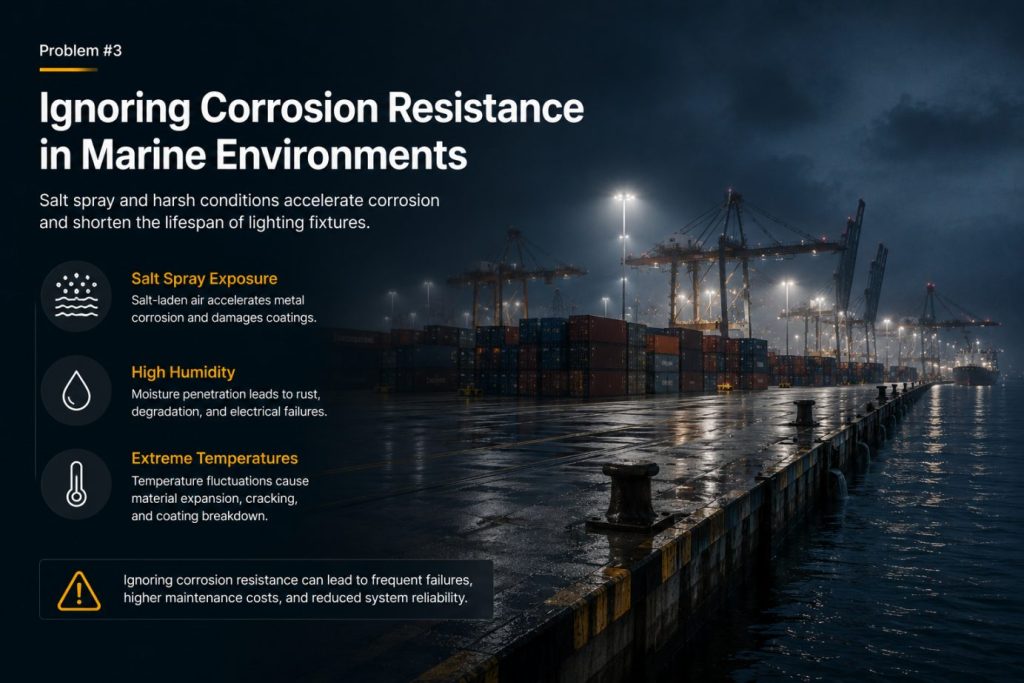

As a result, fixture reliability becomes just as important as lighting performance.
When selecting lighting equipment for ports and marine facilities, engineers should evaluate factors such as:
- IP protection rating
- Housing material
- Surface treatment technology
- Corrosion resistance
- Sealing performance
- Long-term outdoor durability
Choosing fixtures designed specifically for harsh outdoor environments can significantly reduce maintenance costs and improve operational reliability.
Port Lighting Is Not Just About Choosing Higher Wattage
In some projects, increasing the number of fixtures is often seen as the easiest way to achieve higher brightness.
However, for large-scale ports and container terminals, adding more fixtures is not always the most effective solution.
Different areas require different lighting strategies:
- Loading zones prioritize task visibility
- Container yards require uniform illumination
- Internal roads focus on safety and efficiency
- Crane areas demand long-distance light projection
- High-mast lighting systems require large-area coverage
A successful lighting design balances fixture power, beam angle, mounting height, and layout configuration rather than relying solely on fixture quantity.
Choosing the Right Power for Different Port Applications
There is no universal lighting configuration for every port project. The ideal fixture power depends on installation height, operational requirements, and target illumination levels.
|
Application Area |
Recommended Power Range |
Key Consideration |
|
Loading Zones |
100W–300W |
Task visibility |
|
Internal Roads |
300W–600W |
Traffic safety and efficiency |
|
Container Yards |
400W–800W |
Uniform illumination |
|
Crane Operation Areas |
800W–1200W |
Long-distance projection |
|
High Mast Lighting |
1000W–1200W |
Large-area coverage |
MIC LED’s MFL-G Series covers power options from 100W to 1200W, allowing lighting designers to select suitable configurations for different port environments.
Rather than simply choosing higher wattage fixtures, the goal is to match fixture performance with the specific requirements of each operational area.
A Professional Port Lighting Solution Starts with Proper Planning
A reliable port lighting system should consider far more than brightness alone.
Key design factors include:
- Site dimensions
- Pole height
- Operational zones
- Average illumination levels
- Uniformity requirements
- Glare control
- Corrosion resistance
- Long-term maintenance costs
Ignoring these factors during the design stage can result in higher operating expenses and reduced lighting performance over time.
For ports, container terminals, and logistics facilities, lighting is not merely infrastructure—it is an investment in safety, productivity, and long-term operational efficiency.
About MIC LED
MIC LED specializes in outdoor lighting solutions for demanding industrial and infrastructure applications, including ports, container terminals, sports facilities, industrial sites, and high-mast lighting projects.
Our team helps customers select suitable lighting configurations based on project requirements, installation height, site conditions, and illumination standards.
If you are planning a port lighting, container yard lighting, or high-mast lighting project, feel free to contact us for technical support and project consultation.
- Email: micled@mic-led.com
- Website: www.mic-led.com
- WhatsApp: +86 135 4334 3078